What to Have Ready Before a Concrete Cutting Crew Arrives at Your Facility
A little preparation before the saws show up turns a half-day of confusion into a job that starts on time and finishes clean.
September 2, 2026 · 3 min read
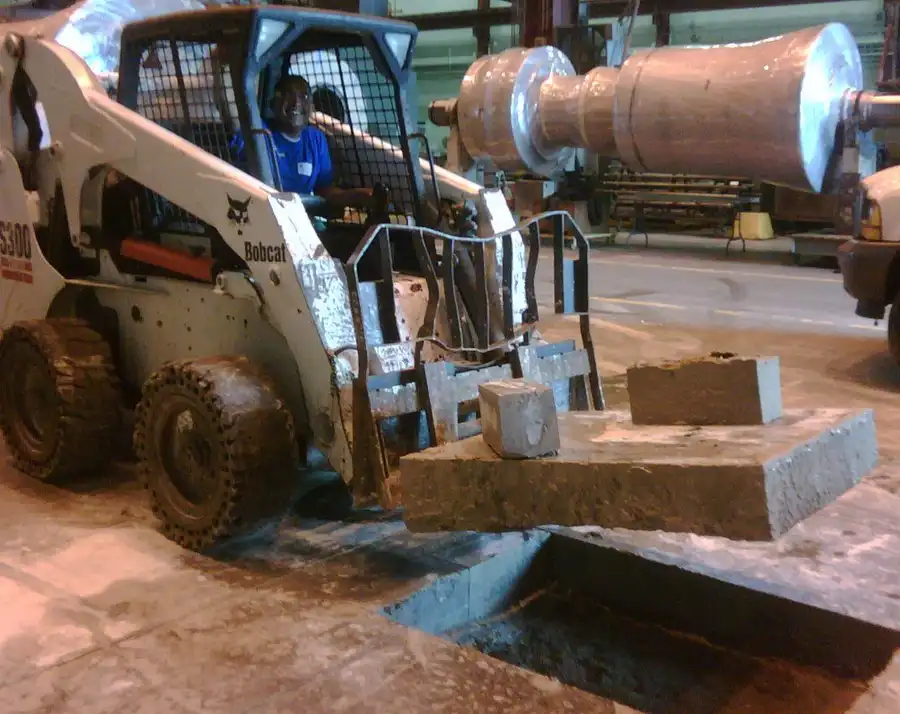
A concrete cutting crew showing up at a working plant is a different job than pulling into a residential driveway. There's a facility running around that crew, production schedules to work around, and equipment on the floor that can't simply be moved out of the way for the afternoon. The jobs that go smoothly are almost always the ones where somebody on the facility side thought through access, power, and what's buried in the slab before the trucks ever showed up.
Clear the path before the trucks arrive
Skid steers, track-mounted wall saws, wire saw rigs, and, if the scope includes breaking and haul-off, dump trucks and roll-off containers all need room to stage and move through the building or the yard. Walk the route from the gate to the actual work area and clear anything that would block a truck, a lift, or a loaded skid steer. If access badges, visitor sign-in, or an escort are required for the area, have that arranged before the crew is standing at the door waiting on a phone call to security.
It also helps to know which power source the crew plans to run. Belknap works with gasoline, diesel, and electric equipment depending on the site and whether the job is indoors or out. If the cut is happening inside an occupied building, ask ahead of time what that means for exhaust, noise, and the water that comes with wet cutting, so the right areas can be closed off before the saw starts.
Power is the question that gets skipped
Belknap runs 480 volt, diesel, and gas powered equipment for standard slab and wall sawing jobs, and they can bring generators to a site if the facility can't power the 480 volt equipment. That second part is worth a phone call before the job, not a discovery after the crew has already unloaded a saw with nowhere to plug in. A plant can have 480 volt three-phase service somewhere in the building and still not have a rated, accessible circuit anywhere near the actual cut, especially in an older section or an addition that was wired for something else. Flag it when the job gets scheduled and a generator goes on the truck instead of getting sorted out after everyone's already standing around.
Know what's under the slab before anyone cuts it
Core drilling and saw cutting both go through concrete that frequently has plumbing lines, electrical runs, and sometimes fire protection piping running through or under it. That's a large part of why core drilling exists as a technique: it's a controlled way to route a line or set an anchor without breaking up the surrounding slab. But controlled only works if somebody knows what's down there first. If the facility has as-built drawings, pull them before the crew arrives. If it doesn't, or if the area is old enough that the drawings might not match reality anymore, a locate on the specific spot being cut is worth arranging ahead, particularly near a machine pit, a trench, or a section of floor that's been repaired or built onto over the years.
Tight spots need a different tool
Not every access point suits a full-size track-mounted saw. Belknap carries ring saws, chainsaws, hydraulic saws, and both gas and electric powered hand saws for situations where the standard equipment doesn't fit or can't reach. If part of the facility has narrow doorways, mezzanine framing, or fixed equipment in the way that can't be relocated, mention it when the job is scheduled. It changes which saw shows up on the truck. It doesn't change whether the job can get done.
- Clear access from the gate to the work area, with room for a skid steer or saw rig to stage
- Badges, escorts, or sign-in procedures for the specific area, sorted ahead of time
- A confirmed answer on 480 volt power near the cut, or a heads-up that a generator will be needed
- As-built drawings, or a recent locate, for anything buried under the slab being cut
- One point of contact on-site who can make a call if something unexpected turns up mid-job
Belknap Concrete Cutting and Drilling has been cutting, coring, and breaking concrete around Houston since 2003, family owned and operated, working commercial and residential jobs across the city and the surrounding area. Because production lines and shutdown windows don't always cooperate with a Monday-to-Friday schedule, the company is available during off hours with 24-hour emergency service. Sorting out access, power, and what's under the slab ahead of time is what keeps that window as short as it needs to be.
Belknap Concrete Cutting and Drilling — (281) 955-6812
Call (281) 955-6812More articles
Wire Sawing, Wall Sawing, Slab Sawing, or Hand Sawing: How the Method Gets Chosen
The four cutting methods solve different problems, and matching the right one to the job is what keeps a cut clean the first time.
What Core Drilling Actually Does to a Home Concrete Slab
A round, controlled hole instead of a broken slab, and what it usually gets used for around a Houston home.